


When it was learned last year that Trump was demolishing the East Wing of the White House, it was just another thing on the long list of things he's done to piss us off. If that isn't controversial enough; it's all for a White House ballroom construction project.
Not unlike when he illegally threw people on planes and forced deportations to El Salvador — the damage was already done. Despite courts demanding the return of those people, he simply ignored the orders and did it anyway. In general, a more extreme case is when someone is executed: once that life is taken, no court order can return it. The damage is done.
This is the kind of defiance Trump exhibits regularly — act first, dare anyone to stop you, and if they do, the wreckage is already behind you.
So, when it came to the White House, he went ahead with the ballroom construction project before seeking input from the National Capital Planning Commission and the Commission of Fine Arts — both of which he had reconstituted with allies and supporters. He stacked the approval bodies with his own people and bypassed the normal process entirely. Construction began during a government shutdown, funded by private donors specifically so federal budget negotiations couldn't touch it.
Even Trump's White House Ballroom Construction Plans Are Lies
Embed from Getty ImagesAccording to a March 29th New York Times investigation, architects identified numerous problems with the design plans for Trump's ballroom, including an exterior grand staircase leading up to a side of the building that has no door, columns that would block interior views and daylight, fake windows, and a staircase that would break the symmetry of the White House driveway planned by Frederick Law Olmsted in the 1930s.
This is the "Great Gift to America" he keeps bragging about?
To his credit — if you can call it that — Trump revealed an updated version of the ballroom the very next day with some issues resolved, including removing the grand staircase that led to nowhere. The rest apparently stays.
But here's what didn't make as many headlines: two magnolia trees were removed during construction in late October 2025. One had been planted by First Lady Florence Harding in 1922. The other was planted in 1942 to commemorate Franklin D. Roosevelt.
Nearly a century of living history, quietly uprooted for a $400 million ballroom with fake windows and a staircase that used to go nowhere.
 Jon Mark
And it gets quieter still. The Presidential Emergency Operations Center beneath the East Wing — the historic FDR-era bunker — was dismantled as part of site preparation. It will be replaced by a new below-grade facility whose cost to taxpayers has not been disclosed. Trump himself admitted "the ballroom essentially becomes a shed for what's being built under." A $400 million shed. Funded by private donors. Over a secret military complex. Whose price tag nobody is allowed to know.
Federal Judge Richard Leon ruled on March 31st that Trump had not received the congressional approval required by law, writing:
"The President of the United States is the steward of the White House for future generations of First Families. He is not, however, the owner!"
But of course — the damage was already done. The East Wing is gone. The magnolia trees are gone. The FDR bunker is gone. None of it is coming back. That's the whole point. That's always the whole point.
And in true form, rather than accept the ruling, Trump called Leon — a George W. Bush appointee — a "Trump hater" for applying the law. The man who demolished a historic wing of the White House without congressional approval, who cut down century-old trees, who replaced an FDR bunker with a secret military complex nobody can put a price on, is now the victim. Amazing, isn't it.
Jon Mark
Authoritarian Monumentalism
Embed from Getty ImagesThere's actually a name for what Trump is doing. Academics call it authoritarian monumentalism — and it has a very long, very ugly history.
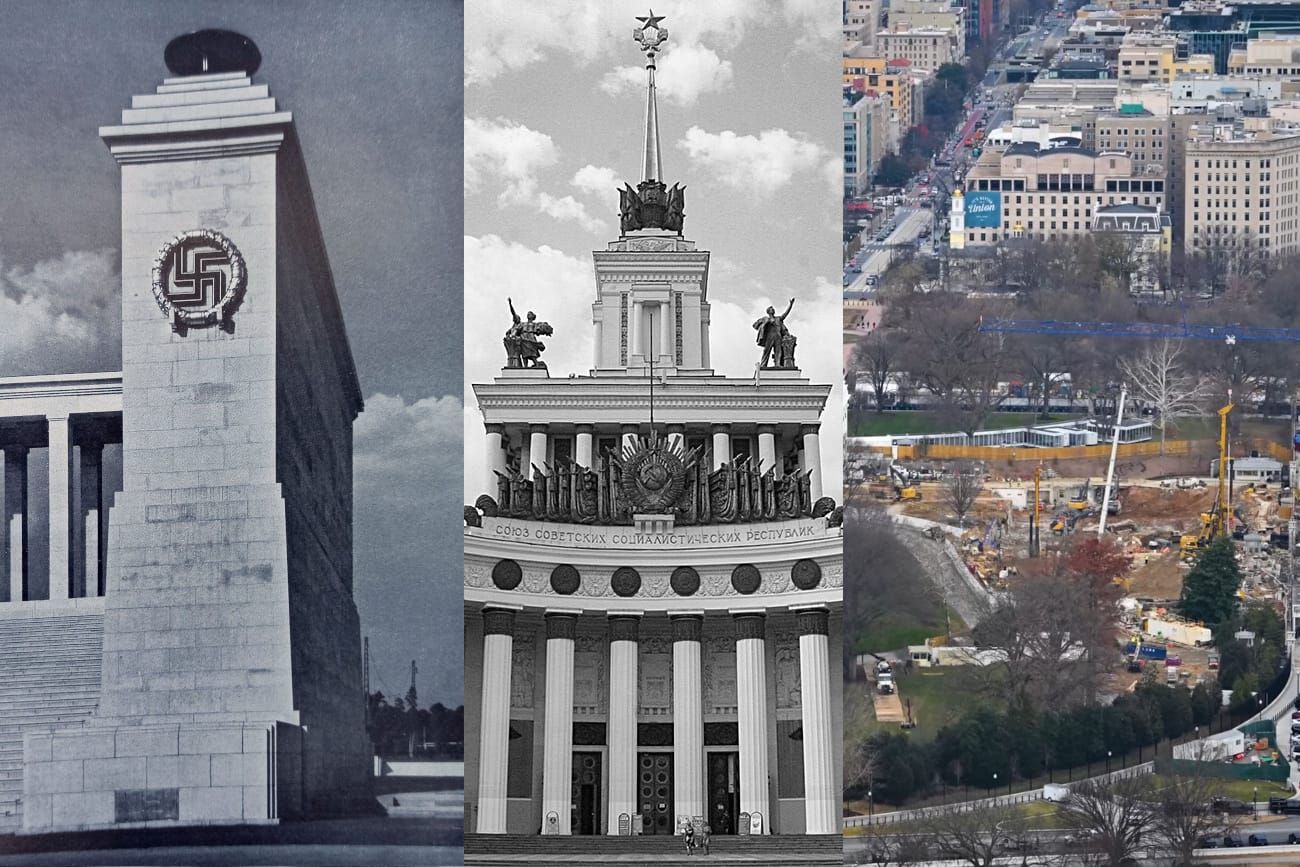
Dictators, tyrants and kings have always built monumental architecture to buttress their own egos. Albert Speer's neoclassical designs for Nazi Germany were intended to overwhelm the individual and glorify the regime, while Stalin suppressed avant-garde architecture in favor of monumental socialist realist structures projecting permanence and centralized power.
The playbook is consistent across centuries and continents: demolish what was there before, replace it with something that bears your name and your aesthetic, and make sure it's big enough that people feel small standing in front of it. Many leaders throughout history have built temples to power while erasing the memory of their predecessors — a practice known as damnatio memoriae, or condemnation to oblivion. The Sumerians did it. The Egyptians did it. The Romans did it. And now a man who lost the popular vote twice is doing it to the White House.
The irony — and it's a rich one — is that Trump spent his first term screaming about Democrats trying to remove Confederate monuments, calling it "a cruel campaign of censorship" and a battle to save the heritage and greatness of the country. The man who said you cannot demolish history just demolished the East Wing of the White House. He uprooted trees planted by Florence Harding and Franklin Roosevelt. He dismantled an FDR-era bunker. Without congressional approval. During a government shutdown. To build a ballroom with fake windows.
Trump has also proposed building his own triumphal arch in Arlington, Virginia — just across the Potomac from the Lincoln Memorial — as a symbol to mark the 250th anniversary of the Declaration of Independence. A triumphal arch. In the tradition of Augustus Caesar, Napoleon Bonaparte, and every other strongman who ever needed a monument to remind people he existed.
George Orwell put it plainly in 1984: "Who controls the past controls the future; who controls the present controls the past."
Trump is not renovating the White House. He is rewriting who owns it. He is erasing what came before him — the trees, the bunker, the wing itself — and replacing it with his name, his aesthetic, his monument. And as Judge Leon reminded him, in the clearest possible language: He is not, however, the owner.